

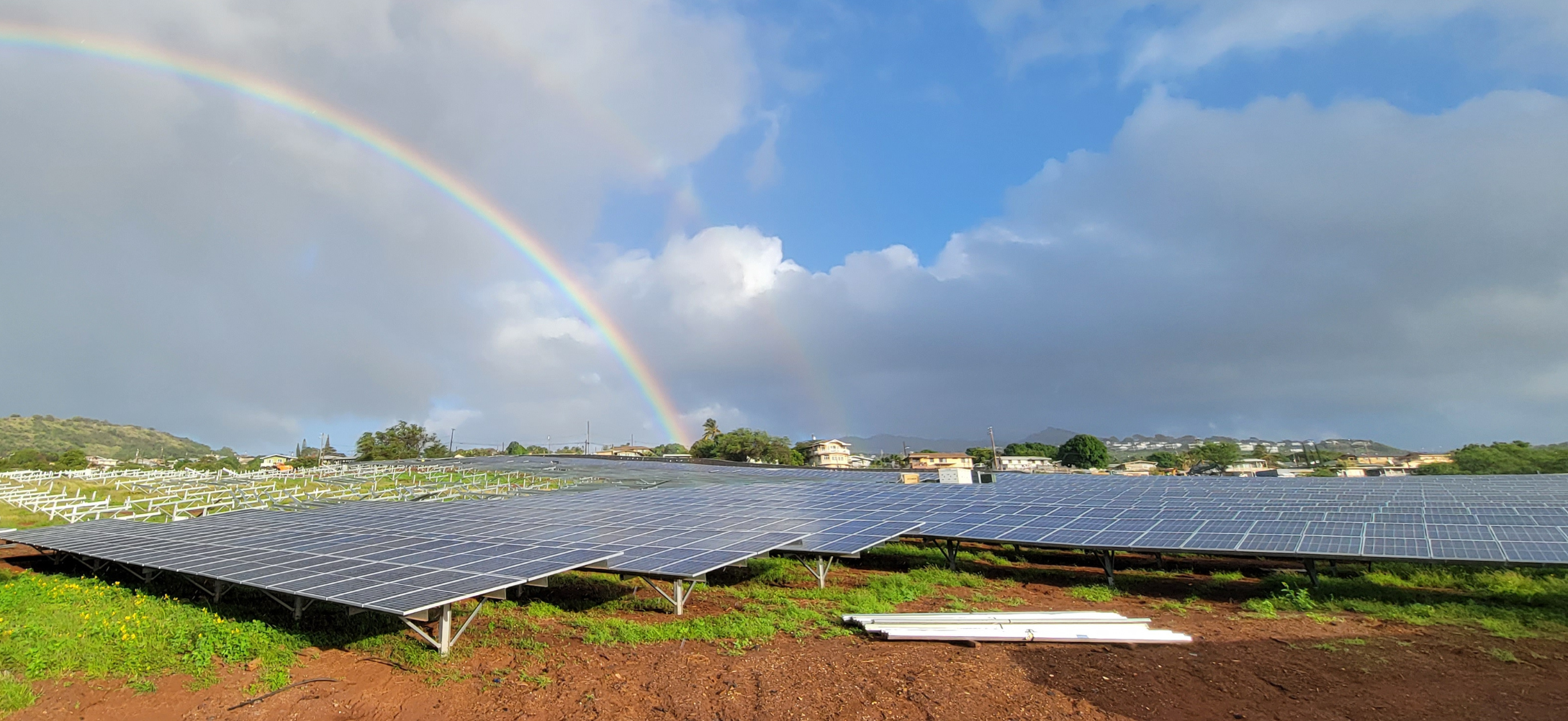
More than half of American households can't install solar panels on their roof. According to the National Renewable Energy Laboratory (NREL), 53.2 million households are locked out of residential solar. They rent, live in apartments, have shaded roofs, or simply can't afford the upfront cost.
That's a problem, especially when electricity prices jumped 6.7% in the past year alone and are projected to climb another 18% by the end of 2026.
Community Solar changes the equation. It lets you tap into clean energy savings without installing a single panel, owning a home, or spending a dollar upfront. Community Solar for renters and homeowners works the same way — you sign up, your bill goes down, and you can cancel anytime. That's it.
If you’re curious about Community Solar, you’ve come to the right place. Here at Altus Power, we are leading the way towards a more affordable future by offering Community Solar to homeowners and renters in multiple states across the country.
In this guide, you'll learn exactly how Community Solar works, how much you can save, who qualifies, and how it compares to installing your own solar system. Whether you're a renter in an apartment wondering if Community Solar is worth it, or a homeowner who doesn't want the hassle of a residential installation, this is everything you need to know.
So, what exactly is Community Solar? Let’s dive in.
Community Solar is a cost savings program that gives residents and businesses shared access to the benefits of solar power — without putting panels on their property. Also called shared solar or virtual solar, it's a form of distributed generation that works in 23 states plus Washington, D.C.
Here's the simple version: Somewhere near you, a photovoltaic solar project generates clean electricity and sends it to the local power grid. You sign up as a subscriber and get a share of that energy as credits on your electric bill. Those Community Solar credits lower your charges. You pay a discounted rate for them, and the difference is your savings.
Nothing changes — your utility company stays the same, and so does your service. The only thing that changes is your bill goes down.
The program has been around for over a decade. It's grown to 10.1 GW of cumulative capacity across the United States. The concept is simple: If you can't bring solar to your home, this model brings savings to your bill. Unlike traditional net metering, which requires panels, Community Solar delivers credits from an offsite project.
And it's growing fast. Installations hit a record 1,745 MW in 2024 — a 35% jump over the prior year.
Want to see if Community Solar is near you? Check your state's availability to find out.
How Does Community Solar Work?
So how does Community Solar work in practice? The program connects you to a nearby solar project that feeds clean energy into the power grid. You subscribe to a share of the project's output, receive credits on your utility bill, and save 5-20% on electricity depending on your location and utility provider — all without installing anything at your home.
Here's the process step by step:
- A solar project is built in your area. Developers build solar farms or arrays in your region. These projects connect to the same power grid your utility uses.
- You subscribe to a share of the project. Your share is based on your historic electricity usage. There's no equipment to install and no changes to your home or apartment.
- The project generates electricity. As the sun hits the panels, clean energy flows into the local grid, reducing the overall carbon footprint of your region's power supply and contributing toward clean energy goals.
- You receive Community Solar credits on your utility bill. Each month, your utility calculates your share of the energy produced and applies credits to your bill. These credits offset a portion of your electricity charges.
- You pay a discounted rate for those credits. Altus Power charges you less for the credits than they're worth on your bill. The gap between the credit value and what you pay is your Community Solar savings.
The whole signup process takes less than 10 minutes. You don't need to be home for an installation. You don't need a roof assessment. You don't need to buy any equipment.
What Doesn't Change
This is the part that surprises people most. When you subscribe:
- Your utility stays the same. You keep your existing electricity provider.
- Your service stays the same. Power delivery, reliability, outage response — all identical.
- Your meter stays the same. Nothing physical changes at your home or building.
- You can cancel anytime. No long-term contracts, no cancellation fees.
Think of it this way: It's like a discount program for your electricity bill that happens to be powered by clean energy.
How does Community Solar help you save money?
As energy costs continue to climb across the country, affordability matters more than ever. Community Solar gives qualifying residents the opportunity to purchase electricity from a nearby solar farm and receive credit on their utility bill for it. The size of the credit you receive depends on the amount of clean energy generated by the solar farm you are subscribed to. The bill credits you receive each month appear as a deduction on your bill and significantly reduce the amount you owe your utility company.
If you’re an Altus subscriber, we’ll bill you for those credits — at a reduced rate — which saves you money overall.
You can expect to see discounts on your bill within two or three billing cycles after you sign up — or two or three billing cycles after your local solar project is powered on, if it’s still under construction. What the billing process looks like, however, depends on whether your account is on Standard Dual Billing or Consolidated Billing. Read more about Community Solar billing methods here.
Most subscribers get between 5% and 20% off the value of their solar credits. The exact Community Solar savings depend on your state, your energy usage, and local utility rates.
In real numbers: If you receive a solar credit of $150 and save 10%, that's $15 off your bill. That adds up to about $180 per year. At 15%, it's $270 per year. (Keep in mind that individual savings depend on how much clean energy the solar farm produces and your home’s energy usage.)
While one month’s savings might not seem life-changing on its own, the savings add up quickly over the year. It’s especially meaningful when you consider the alternative of doing nothing and watching your rates climb.
And those rates are climbing. Residential electricity prices rose 6.7% between June 2024 and June 2025, according to the U.S. Energy Information Administration — that’s a projected increase of 18% by the end of 2026.
The program locks in a discount against whatever your utility charges. So the value actually grows as electricity gets more expensive.
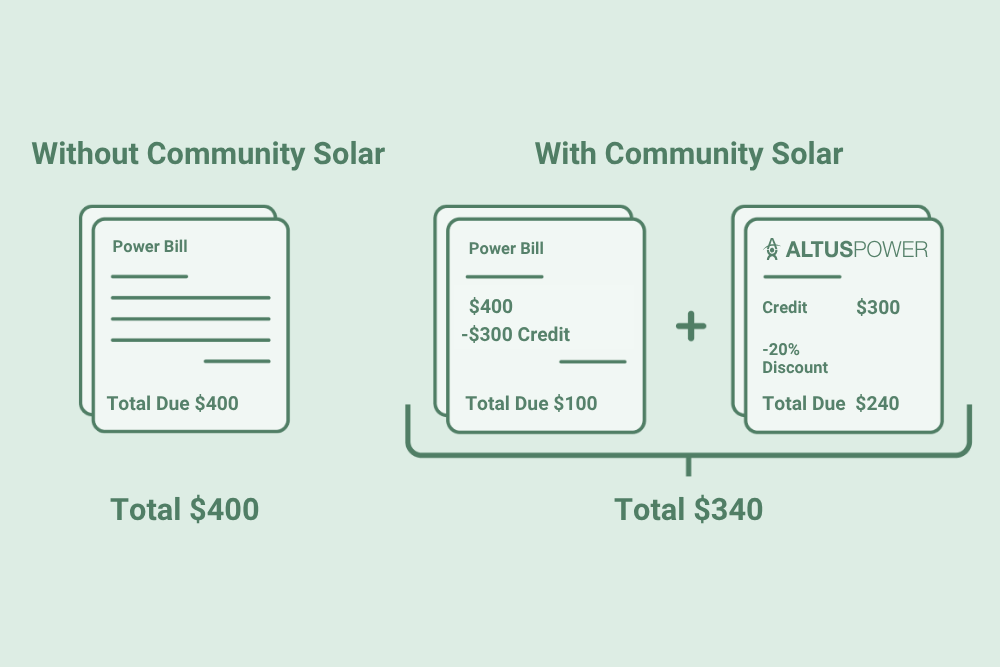
Here’s an example of how Community Solar saves you money:
Let’s say your electric utility bill this month is $400, and you receive a credit of $300 on your bill in exchange for the energy generated from your portion of the solar farm. In other words, you will pay your utility company only $100. Then, Altus will bill you for those solar credits at a discounted rate.
For example, if we agree on a 20% discount, then you’d be paying a total of $340 instead of $400 this month — saving you $60!
A Typical Newark, NJ, Family
When a family moved into a rental apartment in Newark in early 2025, they assumed solar energy wasn't an option. No roof access. No yard. No way to install panels.
Their electricity bill averaged $185 a month, and they'd watched it creep up about $30 over the past two years. Then a neighbor mentioned Community Solar. They signed up in under ten minutes, and within two billing cycles, solar credits started showing up on their utility statement. Their average savings: about $22 a month. Nothing installed, nothing paid upfront, same utility company as before.
The takeaway is the one a lot of renters miss: You don't need to own a house — or a roof — to benefit from solar.
How does Community Solar billing work?
Once you’re enrolled, your utility company applies solar credits to your monthly bill that reduce what you owe. Depending on your state and utility, you’ll either see those savings as a single adjusted total on your utility bill (Consolidated Billing), or you’ll get two bills — your utility bill plus an Altus Power invoice that charges for the credits at your discounted rate (Dual Billing). Either way, your combined annual total is lower than what you would have paid before subscribing.
Seasonal Variation
Your savings aren't perfectly consistent from month to month. Solar panels produce more energy in summer (longer days, more sun) and less in winter. That means your credits may be larger in July than in January.
Over the course of a year, it averages out.
Who Qualifies for Community Solar?
Community Solar eligibility is broad — the program was designed specifically for people who can't or don't want to install panels. If you have a utility bill, you will likely qualify if you live in an eligible state and utility zone.
Renters and Apartment Dwellers
This is the biggest group. If you rent an apartment, townhome, condo, or house, you almost certainly can't install panels. This program gives renters access to clean energy savings with zero equipment and zero changes to your living space.
A 2024 study in Nature Energy by Berkeley Lab and NREL backs this up. Subscribers are 6.1 times more likely to live in multifamily buildings. They're also 4.4 times more likely to rent.
Homeowners
Even if you own your home, residential solar isn't always practical. Your roof might face the wrong direction, be partially shaded, need replacement soon, or fall under HOA restrictions. Subscribing gives homeowners the savings without the installation headaches.
Low-to-Moderate Income Households
Many states have specific provisions to make Community Solar programs accessible to lower-income families. In Maryland, for example, households earning below $75,000 or enrolled in certain assistance programs qualify for additional discounts. New Jersey's new 3,000 MW expansion requires that 51% of subscribers be from low-to-moderate income households.
Businesses and Property Managers
The program isn't just for residential subscribers — in many states and utility zones, small businesses may qualify for Community Solar. Additionally, Altus Power offers partnerships for property managers and landlords where they can offer solar savings as a building amenity.
Choose Shared Solar If:
- You rent your home or apartment
- Your roof isn't suitable for panels (shade, age, orientation)
- You don't want to deal with installation, permits, or maintenance
- You prefer zero upfront cost and zero risk
- You want flexibility to cancel if your situation changes
Is Community Solar Legitimate?
Community Solar is a state-regulated cost savings energy program backed by federal agencies, major utilities, and institutional investors. The "too good to be true" reaction is understandable, but the savings are real, verified, and growing.
It's state-regulated. Community Solar programs operate under state legislation and utility commission oversight. As of 2026, 23 states plus Washington, D.C. have enabling legislation on the books.
It's been operating for over a decade. The model started gaining traction in the early 2010s. Minnesota's program, the longest-running in the nation, has been operating since 2013 and now accounts for 47% of all solar capacity in the state.
Major institutions back it. The U.S. Department of Energy runs the National Community Solar Partnership. The Solar Energy Industries Association tracks it as a core market segment.
How to Spot a Legitimate Provider
- State program participation. Legitimate providers operate within your state's official program.
- No upfront fees. You should never pay to join.
- Clear cancellation terms. Reputable providers let you cancel without penalties.
- Transparent billing. You should understand exactly how credits appear on your bill.
- Track record. Look for established companies with real operating history.
Altus Power has been operating since 2010. We operate 1.3+ GW of commercial solar across 30 states and Washington, DC and serve over 40,000 Community Solar subscribers across nine states.
How does Community Solar Help the environment?
Community Solar subscribers aren’t just saving money — they are actively helping others save money and supplying more clean energy directly into the local power grid, which is then used to power local homes and businesses in the community. That means less reliance on power made from fossil fuels. When our solar farms convert sunlight into usable electricity, neither greenhouses gasses nor other harmful emissions are produced.
Community Solar is a great way for people to support clean energy if they live in an apartment, are renters, do not want to install rooftop panels or face structural or building issues preventing them from installing their own solar panels. The only requirement to participate in Community Solar is having a utility bill — the program is open to homeowners and renters alike, and there are no upfront fees or ongoing subscription costs. Subscribers only pay Altus a percentage of what they save on their electricity costs each month. We share in the savings, and your community gets the benefits as well.
How to Sign Up for Community Solar
Step 1: Check Availability
Community Solar programs are available in select states. Altus Power currently operates in Colorado, Hawaii, Illinois, Maryland, Massachusetts, Minnesota, New Jersey, New York, and Maine. Check your eligibility here.
Step 2: Provide Basic Information
You'll need your name, address, and a recent utility bill. The utility bill helps determine your energy usage so you can be matched to the right share of a solar project.
Step 3: Review and Confirm
You'll see the terms of your subscription, including your expected savings rate and how billing works. Read through the details, confirm your enrollment, and you're done.
Step 4: Start Saving
Within 2-3 billing cycles, solar credits will begin appearing on your utility statement. Your savings show up automatically. No action is needed on your part.
Community Solar by State
New York - One of the largest markets in the country. Strong state support through NYSERDA programs and aggressive clean energy targets.
New Jersey - Recently signed landmark legislation adding 3,000 MW of capacity. The program requires 51% of subscribers to be from low-to-moderate income households.
Maryland - Active program with additional discounts for qualifying low-income households. Scored the highest marks on the 2025 Community Power Scorecard.
Massachusetts - One of the original states and a leader in distributed solar policy.
Minnesota - The longest-running program in the U.S. 47% of all solar capacity in Minnesota comes from shared solar. Hawaii - Strong solar resources and high electricity rates make it an ideal market for subscribers looking to save.
Illinois - Growing program with increasing subscriber base, backed by the Climate and Equitable Jobs Act.
Frequently Asked Questions
Does Community Solar work in winter?
Yes. Solar panels produce electricity year-round, including during winter months. Production is lower in winter due to shorter days and less direct sunlight, but credits still accumulate.
Is Community Solar worth it?
For most people, yes. You save 5-20% on electricity with zero upfront cost, zero installation, and zero risk. Your savings grow as utility rates increase. And you can cancel anytime if your situation changes.
Can renters participate in Community Solar?
Yes, Community Solar for renters is one of the program's core use cases. You don't need to own property, have roof access, or install anything. If you have a utility bill, you can subscribe and start saving.
Can I have residential solar AND Community Solar?
In most cases, no, but it depends on your state and utility provider. Please reach out to hello@altuspower.com to see if you are eligible for Community Solar.
Is this the same as switching energy suppliers?
No. The program doesn't change your energy supplier or utility company. Your utility still delivers your electricity. It adds bill credits on top of your existing service.
What happens if I move?
Solar savings don’t transfer automatically, but if you let us know about your move we can often transfer your subscription to your new home. Fill out our move form with the state you’re relocating to, and a member of our Customer Experience team will reach out to start the transfer — or to cancel if a transfer isn’t possible. The usual eligibility rules apply at your new address.
The Bottom Line
- It's real savings. 5-20% off your solar credits, starting within 2-3 billing cycles.
- It costs nothing to start. Zero upfront fees, zero equipment, zero installation.
- It's risk-free. Cancel anytime with no penalties.
- It's state-regulated. Operating in 23+ states under government oversight.
- It's growing fast. The U.S. now has over 10 GW of capacity, with record installations in 2024.
If you want to read more about Community Solar, here are some articles from the web that we recommend:
Community Solar Makes Renewable Energy Available to All
Community Solar: Access Solar Power Without Rooftop Panels
14 Ways to Save on Your Electric Bill
To see if Community Solar is available in your area, click here and enter your zip code and utility company. To complete your sign up, you will need a copy of your utility bill so be sure to have that handy.
If Community Solar is not currently available in your zip code, please join the waitlist to be contacted when we expand. For questions, concerns, or technical support, reach out to us at hello@altuspower.com any time — we’re always here to help.
Interested in getting started with Community Solar?
Reduce your electricity costs and help your community go green with Community Solar.


.png)